


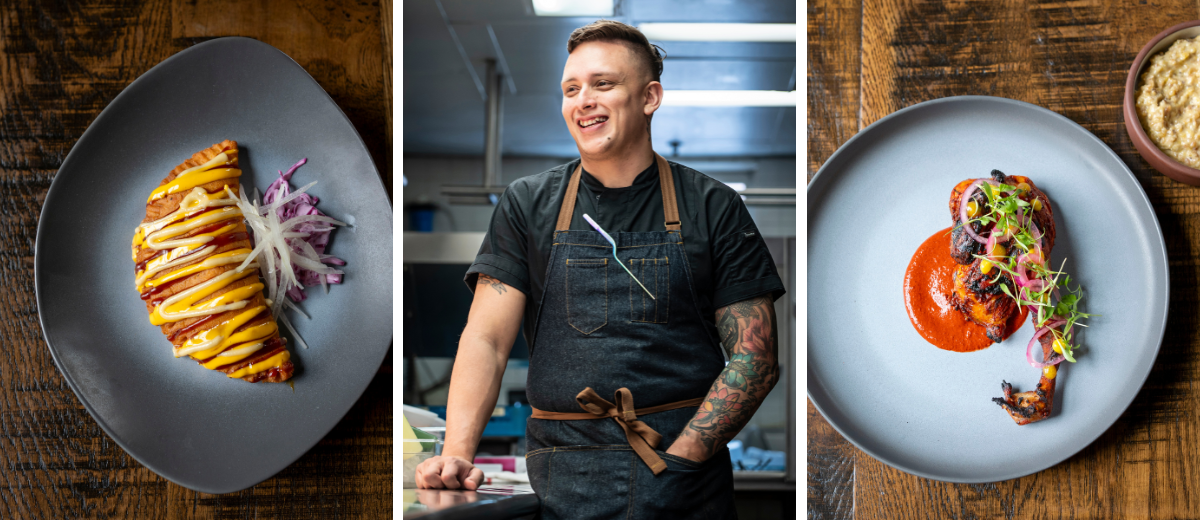
Chef Tomás Chavarría brings a bold, soulful approach to modern cooking, rooted in Costa Rican heritage and shaped by years of discipline and craft. He is the executive chef at The Alexandrian Hotel and Morrison House in Old Town Alexandria, VA. and Be sure to follow his journey on Instagram.
You oversee culinary programming across two hotel properties — what inspired you to take on that broader leadership role and how has your vision evolved from hands-on chef to multi-venue steward?
For me, it started with wanting to make an impact that went beyond a single kitchen. When I was on the line, everything revolved around the plate — every sear, every sauce, every detail. But as I grew, I realized that real leadership is about shaping culture, not just menus. Taking on multiple properties gave me the chance to mentor, to build consistency, without losing individuality.
My vision now is to lead from behind the scenes, ensuring each property tells its own story while upholding the same respect for ingredients, teamwork and our guests. It’s not about being everywhere; it’s about building teams who lead with heart and pride, and who embody our company’s commitment to “enriching lives one experience at a time.”
Early in your career you spent time working in the Philippines , what experiences there shaped your culinary sensibility, and are there flavors or techniques from your time there that you still revisit today?
The Philippines changed me. It was the first time I truly understood the soul behind humble ingredients. I learned the beauty of balance . How vinegar lifts richness, how coconut brings warmth, how food connects people even without a shared language. That experience still shapes the way I cook today. The slow braises, the bright acidity, the honest comfort of Filipino food remind me of my own Costa Rican roots, dishes meant to be shared, rooted in family, struggle, and joy, and carrying the stories of the people who make them
Managing multiple kitchens means balancing creativity, operations and team culture. How do you ensure each property reflects its own identity while maintaining your overarching culinary philosophy?
It all starts with the chefs. You can’t fake culture, you build it through people. Each property has its own heartbeat, and my role is to pair the right chef with the right rhythm. I set the philosophy: cook with integrity, respect the seasons, and always honor the guest. From there, I give them freedom. I don’t want clones, I want chefs who create with purpose. Whether it’s a seafood-driven kitchen by the coast or a Southern-inspired restaurant, every concept still shares the same DNA: authenticity, precision, and soul.
You’re also a jiu-jitsu practitioner — many high-profile chefs find martial arts play a role in their discipline, mindset or physical stamina. How has jiu-jitsu influenced your approach in the kitchen, and vice versa?
Jiu-jitsu taught me humility and focus. On the mats at Ascend Jiu-Jitsu with Sean Stoopman, where I’m one of his brown belt competitors, there’s no room for ego. You learn by getting humbled, by showing up, by improving inch by inch. It’s the same in the kitchen. Every service is a roll, you adapt, read the energy, and move with intent.
Both worlds demand respect — for your craft, your opponent, your teammates. Jiu-jitsu gives me balance and clarity. It teaches me to breathe under pressure and find calm in chaos. A mindset that has carried me through more kitchens than I can count.

With hotel properties you’re cooking for a wide range of guests — from in-house diners to event banquets to destination travelers. How do you tailor menus and experiences to meet those varying expectations?
For me, it’s all about connection. In the restaurant, I want every dish to tell a story — something seasonal, rooted in the region, and personal. For events, the goal is to create moments that feel effortless but unforgettable.
We build menus with intention: local seafood, small farmers, and flavors that reflect a sense of place shaped by global technique. I want every guest to taste care, to feel like the food was created specifically for them.
Looking ahead, what are the biggest growth areas you’re targeting — whether it’s sustainability, guest experience, chef-driven pop-ups, regional sourcing — and what milestone would you like to hit in the next 12-18 months?
I want to push even harder into true local sourcing and real sustainability. The kind that makes the Michelin Guide look toward the DMV* not because of trends, but because of impact. Not the buzzword version, but practices that actually support our farmers, our fishermen, and our community while reducing waste in meaningful ways. We’re already doing the work, and I want to take it further.
Another major goal is expanding our chef-driven experiences. More pop-ups, more collaborations, and hopefully bringing in visiting chefs from Latin America to share their craft. I’d love to create more storytelling dinners that connect cultures all on one table, much like what we’ve begun with our Chef’s Supper Clubs at King & Rye and our tasting menus at The Study.
*DC/Maryland/Virginia region
Finally, when you step away from service and roll up your gi* for the day — what gives you joy, recharges you, and reminds you why you swept the mat and turned the oven on in the first place?
Honestly, it’s the simple things. Cooking at home, listening to music, sharing a meal with family and friends, spending time with my dogs, that’s my reset. Even walking through a market and finding that one ingredient that reminds me of home in Costa Rica hits deeper than anything else.
Food and martial arts both teach gratitude. You show up every day because they keep you humble, connected, and present. That balance, the constant push to get better, grounded by a full heart is what keeps me going.
*judo uniform